
Updated October 2026.
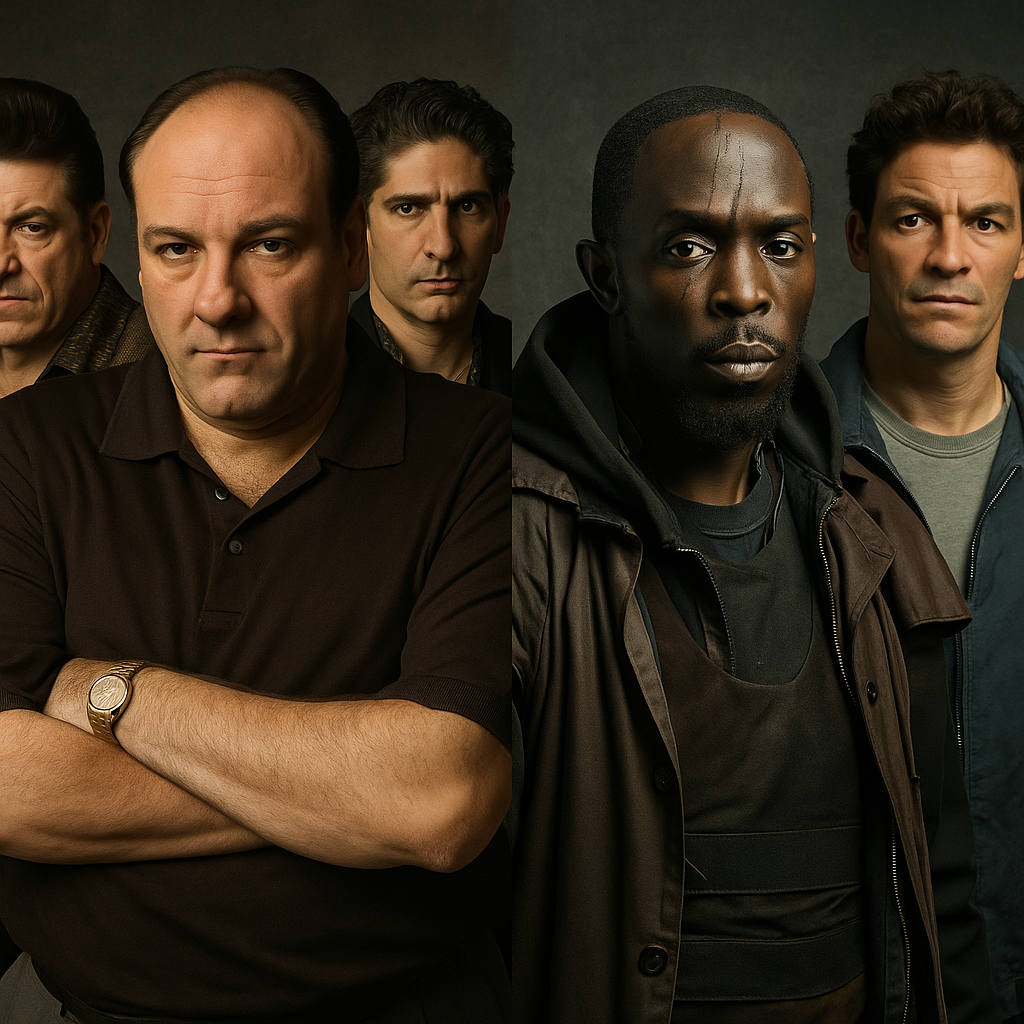
After recently finishing The Sopranos (and being a long-time fan of The Wire – please read my review if you haven’t yet), I knew I had to write this comparison. These two iconic series didn’t just change television – they redefined it. Multi-dimensional characters you can relate to, living in a world far from perfect, great scripts combined with brilliant acting.
Back in the late 90s and early 2000s, most series were still pretty straightforward. They lacked depth. You knew what you were getting. There was Seinfeld for comedy, Sex and the City for drama-comedy, Twin Peaks for mystery-thriller, The X-Files for sci-fi, and the list goes on. Each show had its genre. Its lane. Its expectations. You kind of knew what to expect before you even pressed play.
Those who want respect, give respect.
Tony Soprano, The Sopranos
But then came The Sopranos (1999–2007).
And you know that urge to write about something when it sits with you for too long? If there’s one thing I know how to do, it’s comparing two cultural giants with enough depth to do them justice.
To start, I’d say this: The Wire (2002–2008) might not have existed in the form we know and love without The Sopranos paving the way for bold, layered character development. Still, I wouldn’t say The Wire owes much to The Sopranos beyond that. But the influence? Undeniable.
Man, money ain’t got no owners. Only spenders.
Omar Little, The Wire
Both are exceptional in their own ways. And because this really is an apples-and-oranges situation, the temptation to dive into their differences (and the subtle brilliance in each) is too strong to ignore. So here we go: the nuances, the storytelling, the style, the little details that make these two series unforgettable.
This post was partly inspired by an excellent Vulture article comparing The Wire and The Sopranos. While I’ve taken the idea and added my own categories, rewatches, frustrations and personal spin, credit where credit’s due: great writing sparks more writing.
Listen to this story
Short on time? Here is a 5 minute summary in English.
AI narrated. Read at a slightly slower pace, so it’s easier to follow if English isn’t your first language. Contains spoilers for both series, including the endings.
🧭 In this post
The Wire makes you work for it. The Sopranos doesn’t have to
I’d say this, roughly: if you like The Wire, you’ll most likely appreciate The Sopranos. The real dilemma comes when you flip it. Don’t get me wrong – The Sopranos audience can absolutely get a lot out of The Wire. But the truth is, The Sopranos was (and still is) hyper-mainstream. The Wire never was.
The Sopranos is one of those shows people are expected to like. Back when it was airing, that actually put me off watching even an episode or two. If something goes too far into the hype zone, I tend to lose interest. And let’s be honest – for some, saying you love The Sopranos has also become a kind of cultural badge. Like, “I watch serious TV.” That’s part of its legacy too.
But The Wire? You have to earn that one. You need to push through at least a full season before you’re fully hooked. The Sopranos grabs you way faster.
The showdown: ten categories
⚠️ Spoiler warning: if you haven’t seen both The Sopranos and The Wire, stop reading now. I’ll be diving into everything – yes, that includes the endings, major plot points, and some of the shows’ most defining moments. You’ve been warned.
Still with me? Good.
This isn’t just a ranking. It’s not a “which one is better?” debate either. It’s a breakdown of what each series did exceptionally well – from characters to soundtracks, overlooked details to lasting cultural relevance. Both shows are iconic, but for completely different reasons. And that’s exactly what makes comparing them so fascinating.
So here we go. Ten categories, brutally honest takes, and no blind loyalty. Let’s see how The Sopranos 🟩 and The Wire 🟦 hold up in 2026.
1. Most Complex Side Character
🏆 Winner: The Sopranos 🟩
Christopher Moltisanti, played by Michael Imperioli, begins as an unlikeable and arrogant young man. He is cheeky, impulsive and desperate for attention among the mobsters. At first he seems reckless and self-centred, often acting out of insecurity and frustration. But as the series progresses, Christopher becomes increasingly relatable and tragic. His vulnerabilities come to the surface: his ongoing struggle with addiction, his need for Tony’s approval, and the deep conflict between wanting to be a respected mobster and a legitimate screenwriter. His battle with alcohol and drugs adds another layer of pain and humanity, showing a man torn apart by loyalty, ambition and self-destruction.
2. Best Character Growth
🏆 Winner: The Wire 🟦
This one goes to The Wire, with D’Angelo Barksdale (Larry Gilliard Jr.). When someone slowly realises that the life they’re living isn’t who they want to be, it’s sad. With D’Angelo, it’s heartbreaking. At the start he is a loyal member of the Barksdale drug crew, but he’s not like the others. The violence bothers him, and he starts questioning the rules of the game. In prison he tries to break free by reading, reflecting and even distancing himself from the Barksdales, but in the world they live in, there is no way out. When you’re part of the family, you’re part of the family.
3. Most Iconic Character
🏆 Winner: The Wire 🟦
The Wire, most definitely. Omar Little (played by Michael K. Williams) is a modern-day Robin Hood who robs street-level drug dealers. In a way he is a bad guy, but a good one. One of the most versatile characters in TV history.
When people hear or see Omar approaching, they usually run in fear, often shouting “Omar comin’!” to warn others. He lives by a strict moral code, never hurting innocent people, and that sets him apart from everyone else on the streets. His life as an openly gay man in that world is a stark contrast to the typical macho image of violent criminals. Omar’s death in the final season is a shocking and truly tragic end to his character. It marks the end of an era for the show, and the way it happens is completely unexpected. There would be no The Wire without Omar. Or if there were, it would be a very different series.
4. Best Use of Detail
🏆 Winner: The Wire 🟦
Hah, not even close – The Wire for sure! The use of detail is a fundamental part of The Wire’s storytelling. Let’s make one thing clear: The Wire refuses to give you what you expect. Each season shifts focus entirely, almost like watching five different shows with the same soul. That’s part of what makes it layered, alive, and still unmatched to this day.
What makes The Wire excellent is how each season builds a bigger picture. It starts with the corners, moves to the docks, then city hall, the schools, and finally the media. You think it’s about drugs, then realise it’s about institutions. One story, five lenses. Every layer reveals how power protects itself and failure gets passed down like tradition. By the end, it’s not about who wins, it’s about why no one ever really does.
5. Best Soundtrack
🏆 Winner: The Sopranos 🟩
You already know it’s The Sopranos. One of the key strengths of the Sopranos soundtrack is how closely it ties into the show’s themes and characters. The Rolling Stones, Bruce Springsteen, Ella Fitzgerald, Journey, Eurythmics and much more, from rap and hip hop to mainstream pop, jazz and classic rock.
6. Most Timeless Themes
🏆 Winner: The Sopranos 🟩
The Sopranos wins for timeless themes because it deals with struggles that almost everyone can relate to, one way or another. The show looks at personal issues like family, identity and masculinity, all of which people have faced throughout history. Tony’s battle with his own mental health, his troubled family life, and the conflict between old values and new changes are still relevant today and will be tomorrow. The way the show explores how men deal with their emotions, and the problems they face because of that, is something we can all connect to, no matter the time period.
7. Strongest Social Commentary
🏆 Winner: The Wire 🟦
This was supposed to be close. It wasn’t. The Wire.
One of The Wire’s most powerful and enduring themes is the failure of institutions and the war on drugs, and it tackles this on every level: police, politics, schools, labour unions and the media. Poverty, inequality, working-class struggles, the power of corruption. The Wire explores these themes with such depth, realism and complexity that its relevance doesn’t fade over time. The show doesn’t moralise; it simply presents the harsh realities of life in a city where institutions are broken and individuals are struggling to survive. This stark realism, combined with its raw, nuanced approach to character and society, makes its themes incredibly timeless.
8. Most Rewatchable
🏆 Winner: The Wire 🟦
Easy win. I watched The Wire once and knew I had to watch it again. It took 15 years, but when I finally did, I loved it even more. The layers, the connections, the things you missed the first time? Worth it. The Sopranos, on the other hand, had whole stretches (about 1.5 seasons) where I just didn’t feel like watching at all. If I rated only seasons 1–3 and 6, it might be in my top 3 of all series. But the rest? Dragged it down to more like top 10.
9. Most Underrated Element
🏆 Winner: The Sopranos 🟩
You already know it’s the humour in The Sopranos. What makes it great is how The Sopranos doesn’t shy away from the absurdity of mob life. The little, everyday things Tony and his crew do, like their arguments, their superstitions, or how they treat their jobs like just another 9-to-5, make the whole thing so enjoyable. The humour often comes from their flaws or awkward situations, and it’s never forced. It feels natural because, despite all the violence and crime, they’re still just people trying to get by.
10. Aged Best (2026 Edition)
🏆 Winner: The Wire 🟦
The Wire, absolutely, always and forever. Its core themes are timeless and continue to hit harder than ever. Even though it aired in the early 2000s, everything about the show, like its take on institutional corruption, economic inequality, racial injustice and the failure of the war on drugs, feels incredibly relevant today. The show’s portrayal of the media’s slide into sensationalism and profit-driven narratives feels even more true in 2026. With the rise of fake news, clickbait and social media, its warnings about how the media shapes our understanding of reality are spot on.
Final scoreboard: The Wire 6 – 4 The Sopranos
| # | Category | Winner |
|---|---|---|
| 1 | Most Complex Side Character | The Sopranos 🟩 |
| 2 | Best Character Growth | The Wire 🟦 |
| 3 | Most Iconic Character | The Wire 🟦 |
| 4 | Best Use of Detail | The Wire 🟦 |
| 5 | Best Soundtrack | The Sopranos 🟩 |
| 6 | Most Timeless Themes | The Sopranos 🟩 |
| 7 | Strongest Social Commentary | The Wire 🟦 |
| 8 | Most Rewatchable | The Wire 🟦 |
| 9 | Most Underrated Element | The Sopranos 🟩 |
| 10 | Aged Best (2026) | The Wire 🟦 |
| Total | The Wire 6 🟦 – 4 The Sopranos 🟩 |
The Wire takes the crown! 👑 Its timeless relevance, deep social commentary and unmatched storytelling make it the ultimate winner. 💯
If I were the creator: How I would’ve done the series
It’s worth saying: watching these shows now isn’t the same as seeing them when they first aired. The world was different. TV was different. That context matters, and maybe the experience would’ve felt completely different back then.
That said, here’s the truth: The Wire’s first season just wasn’t good. It was confusing, slow, and overloaded with characters you couldn’t tell apart yet. You had to work to keep up, and I get why many people dropped it early. Meanwhile, The Sopranos dragged painfully in seasons 4 and 5. By mid-season 5, it finally picked up again, but getting there? A struggle.
And then there were the dream sequences. The Sopranos got a little too carried away with Tony’s visions and symbolism. They didn’t always add depth; sometimes they just killed the momentum. On the flip side, The Wire could’ve used more action. Not explosions and car chases, but moments of pace. Too many scenes leaned into realism, and it sometimes felt like you were being tested instead of entertained. So no, I don’t think either show is perfect. But if I were in the writers’ room?
🟩 The Sopranos
AJ’s struggles needed real direction
AJ spent most of the series feeling lost. Too lost. His sudden shift toward militarism later on felt forced, like the writers needed to give him a quick edge. A more natural progression would’ve been to let him explore different identities: college, work, maybe even political activism. By season 3, he could’ve started to see the cracks in Tony’s world, not just by being told about them, but by witnessing the violence, the fear and the emotional toll it took on the family. That would’ve made his internal conflict believable. What if he had gone to the police? Not as a twist, but as a consequence of watching everything around him decay? Suddenly, Tony’s son isn’t just drifting – he’s a threat. And Tony’s paranoia kicks in. Could he protect AJ? Could he even trust him? Could he kill him?
More for Carmela, and more to test the marriage
Carmela’s role in The Sopranos could have been much more complex. As it is, she is a bit of an add-on wifey character. From the beginning, she knows the dangers of Tony’s world, but she chooses to stay for the security and love he provides. What if she had started questioning this sooner, maybe by season 2 or 3? By this point, she could have begun to feel trapped, not just by Tony’s mafia lifestyle, but by the moral compromises it forces her to make. Instead of simply accepting Tony’s world, Carmela could have opened up to AJ, sharing her frustrations and doubts about the life they’ve built. There was a moment with a priest, but nothing really came of it.
By season 4 or 5, Carmela could have started to challenge Tony more directly. She could have confronted him about his lies, his affairs, and the growing risks he’s putting the family through. This would have created serious tension between them, raising the question of whether Carmela could continue living this life. What if she briefly considered leaving him, or even had an affair of her own? Even better, what if she considered talking to the police? This would have taken the moral stakes to a new level, complicating the family dynamics and further exploring Carmela’s role in Tony’s world. What if Carmela could have taken Tony’s place?
Tony Soprano’s inner life
If Tony had spent too much time diving into therapy, it could have caused him to become more detached from his family’s struggles. His obsession with his inner life might have led him to miss the warning signs that his family was falling apart. While he focused on self-understanding, he would fail to notice the growing dissatisfaction in his children and wife. The family’s struggles, AJ’s confusion, Carmela’s dissatisfaction, could have gone unnoticed as Tony became more self-absorbed. His emotional turmoil might have caused him to lose touch with his instincts, which had always guided his decisions in the mob. As a result, the family dynamics would gradually break down, and Tony would become a much weaker leader. The more he overanalysed his own emotions, the less aware he’d be of the danger his actions posed to his family and business. The slow burn of these personal crises would have added even greater tension to the show.
The FBI’s role
In the show, the FBI often felt like a background subplot rather than a consistent threat. If the investigation had been more intelligent and persistent, it would have put a lot more pressure on Tony. Imagine if the FBI had gotten close to cracking him by season 3 or 4, forcing him to make more difficult decisions. They could have been a much bigger part of the story, influencing Tony’s choices and creating more tension in every interaction. If the investigation had been more than just an occasional obstacle, it would have turned Tony’s world upside down in a way that felt more realistic and relentless.
Deeper exploration of Junior’s character
Junior Soprano was an important character, but he became boring and predictable in later seasons. Instead of just watching him decline mentally, it would have been interesting to see more twists in his character. What if Junior wasn’t actually losing his mind, but was faking it as part of a longer con? Maybe he was playing everyone, including Tony, and still had some surprises left for the younger generation. There could have been a lot more complexity in Junior’s character, showing that he still had control over the family in ways we didn’t expect.
More politicians and the political side of the mafia
We never really explored the political side of the mafia in The Sopranos, even though it’s a huge part of how organised crime operates. Imagine if the show had delved into how the mob interacts with politicians, how business deals are made, or how alliances are formed with influential figures. This side of mafia life could have added a lot of intrigue and complexity, showing just how deep the corruption went. The business side of the operations – money laundering, building alliances, mob families interacting – could have been a more engaging storyline than focusing solely on the day-to-day lives of the characters. What if Tony and his crew had someone representing their interests in politics, killed him in season 1, and the backlash unfolded piece by piece in later episodes?
Mobster stereotyping
While The Sopranos did an excellent job of portraying mob life, there were still moments when characters fell into stereotypical roles. For example, Paulie was often portrayed as the “tough guy” without much depth beyond that. What if we saw more of Paulie’s background, his fears, or the reasons behind his behaviour? Similarly, Silvio’s loyalty to Tony could have been explored further.
These characters could have had more personal backstories or motivations that went beyond the typical mobster tropes. By breaking free from stereotypes, the show would have let the audience see these mobsters as complicated, human characters, not just gangster archetypes.
🟦 The Wire
Remake of season 1
Season 1 of The Wire threw way too many characters at you, all at once. It was overwhelming, especially when you didn’t yet know who mattered or what the stakes were. A better approach would’ve been to focus on just a few key individuals from the start. Build depth, not confusion. Let us sit with them long enough to care. Even better, the season could’ve centred on people from different gangs or crews – not just one drug organisation – so we’d see the contrasts in how they operate, think and survive. Highlight the moral grey zones between them. That would’ve helped viewers understand the world from multiple angles right away, instead of slowly piecing it together through scattered plotlines and names you forgot ten minutes later.
More emotional hooks early on
The Wire was brilliant, but distant for a long time. It took a while to feel anything for anyone. What if we saw more of their personal lives from the beginning? Not just institutional struggles, but the quiet heartbreaks, relationships and small joys that make you care about characters before they become tragic. I would have loved it if the series had let the audience feel the loss before showing them the system.
More intersections between worlds
One of the show’s big themes was that every institution is broken, but what if they crossed over more directly? A cop ends up working in city politics. A kid from the school system ends up writing for the local newspaper. The storylines often ran parallel but rarely collided. If they had, it would’ve made the consequences even more powerful.
Better ending
The Wire ends with the idea that nothing really changes. And that’s real, I get it. But what if one small thing did change? A minor character breaking the cycle, even in a small way. Not a fairytale, just a crack of hope in a world that has none. Because sometimes realism is even harder to take when there’s no movement at all.
Closing remarks
In the end, The Sopranos and The Wire are two sides of the same coin. Both reshaped television, each in its own way. While The Sopranos gave us a complex look at the inner struggles of a mob boss, The Wire pulled back the curtain on the systemic rot of American institutions. Both shows have left a lasting mark on culture and continue to resonate, years after their final episodes aired. Both were HBO series, which made me realise something. I love Netflix, but if series like these two come from HBO, Netflix still has some catching up to do.
The ending: open curtain vs. full circle
Let’s be honest. Neither of these endings was meant to wrap things up with a bow. And that’s exactly why they’re still debated.
The Sopranos cut to black. Literally. One moment you’re deep in the tension of a family dinner – and then, silence. People thought their TVs had broken. But no, that was the point. It’s bold. It doesn’t explain. It doesn’t need to. It throws the ending right back at us: What do you think happened? Love it or hate it, it became one of the most iconic “non-endings” in television. And the truth is, it matched the show’s tone. Tony’s world was never clean or certain – so why would his ending be?
And let’s face it: you’ll never hear Journey’s Don’t Stop Believin’ the same way again. Ever.
The Wire’s ending doesn’t feel like an ending. A corner boy dies, and another takes his place. One honest cop gets pushed out, another learns to play by the rules. A smart kid slips through the cracks, and the machine keeps running. The cycle repeats – not because no one tries, but because the system is built to stay broken.
Shock value and symbolism (Sopranos) – or structural truth and quiet tragedy (Wire). Both endings stayed true to the world they built. And that’s rare.
Ultimately, which show is “better” is a matter of personal preference, whether you lean towards the raw, gritty realism of The Wire, or the sharp, character-driven complexity of The Sopranos. But one thing’s for sure: they’ve both earned their places at the top of everything.
As we look ahead to the future of series, we can only hope that new shows continue to push boundaries, just as these two did. Until then, we’ll be rewatching the classics, diving deep into their themes, and trying to figure out exactly what we’ve learned from them.
Which show is for you? Let me know your thoughts in the comments below!
📺 Read next
- The Wire: A Series Like No Other – my full review of the winner
- The Ultimate Movie List: My Top 100 Films – from 100 all the way to number one



Leave a Reply