
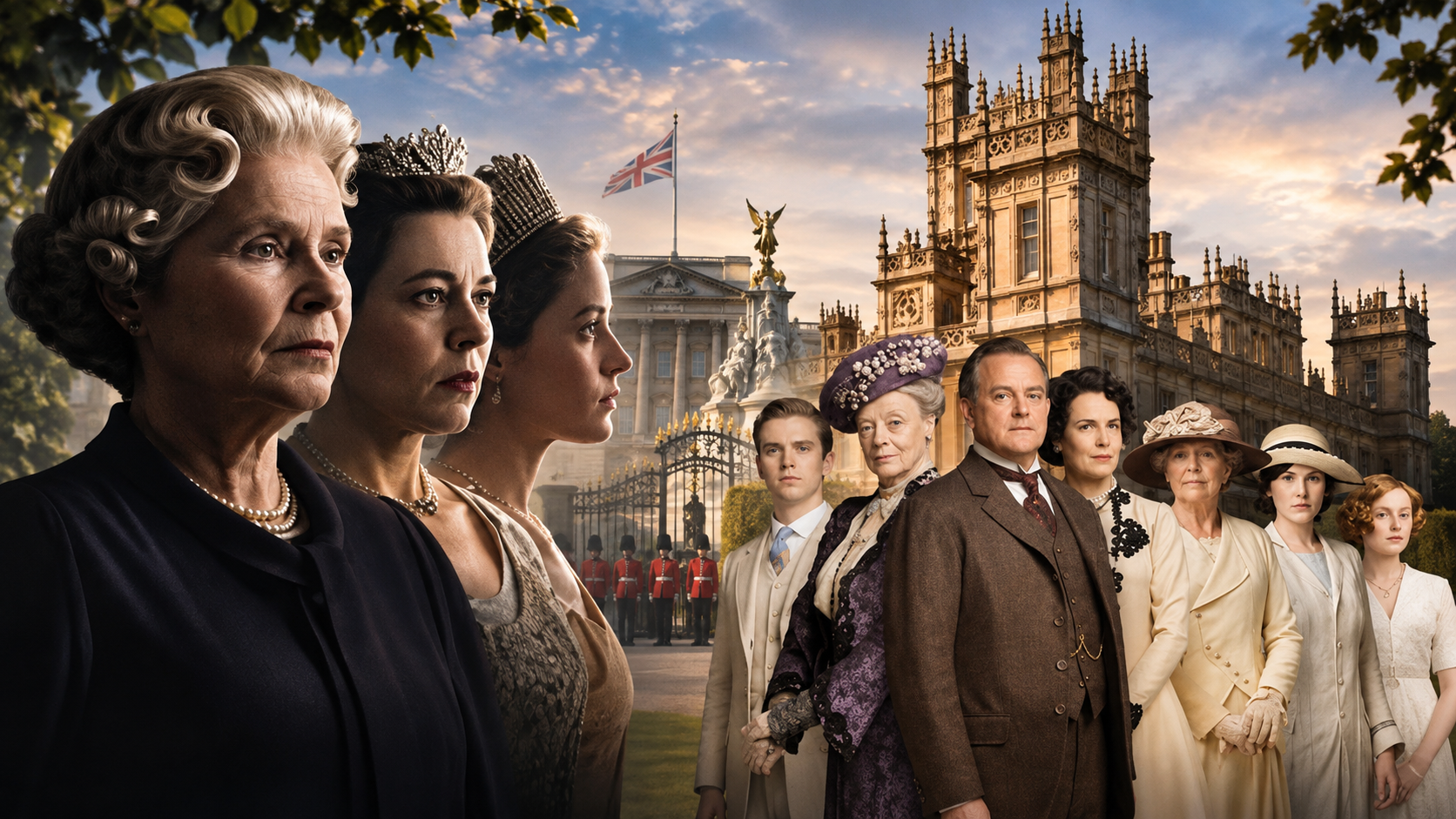
Watching from Finland, where royalty and aristocratic estates are absent from everyday life, the world of British period dramas feels beautifully distant. That escapism is precisely why The Crown and Downton Abbey are so fascinating and why their differences are so stark.
While both shows share the same island and the same teacups, they operate on completely opposite frequencies. Downton Abbey is a warm blanket of nostalgia, offering comfort through family, community, and romanticized traditions. The Crown, by contrast, is a cold dissection of institution and power, exploring the devastating personal cost of putting public duty above individual happiness.
This isn’t a historical fact-checking exercise. Instead, let’s look at what these two cultural giants actually say about class, power, and why we remain obsessed with a past we never lived.
Listen to this story
Short on time? Here is a 4.5 minute summary in English.
AI narrated. Read at a slightly slower pace, so it’s easier to follow if English isn’t your first language. Contains spoilers for both series.
Kiire? Tässä noin 7 minuutin tiivistelmä suomeksi.
Tekoälyn lukema. Sisältää juonipaljastuksia molemmista sarjoista.
🧭 In this post
Same Britain, different questions
- 👑 The Crown: Netflix, 2016–2023, six seasons, following Queen Elizabeth II and her family from the late 1940s to the mid-2000s.
- 🏰 Downton Abbey: ITV, 2010–2015, six series, following the fictional Crawley family and their servants from the sinking of the Titanic in 1912 to the mid-1920s, followed by films that continued the story.
If you love one, chances are you’ll enjoy the other, but probably for entirely different reasons.
Downton Abbey is like a warm embrace. You enter a world where everyone knows their place, dinner is always an occasion, and even the most dramatic family crisis can usually be resolved with a cup of tea, a carefully worded conversation, or, failing that, the next Christmas special. The world may be changing outside, but inside Downton, there is comfort in knowing how things work.
The Crown, on the other hand, offers no such comfort. It is like being trapped in a conversation where every possible answer comes at a price. Every decision carries consequences, every personal desire must be weighed against public expectations, and almost nobody gets what they truly want. The message rarely changes: duty comes first, feelings can wait.
The cultural lens: class, empire, women and Americans
This is the part I find most interesting. Strip away the costumes and both shows are really arguments about how a society holds itself together.
Class: who gets a story
Downton’s great trick is making class feel like a family. The Crawleys and their servants depend on each other, and the show spends nearly as much time in the kitchen as in the drawing room. It is a gentle version of hierarchy, one where loyalty runs in both directions and the real villain is usually change itself. The Crown spends almost no time below the stairs. Ordinary Britons arrive in the story mostly as weather: strikes, crowds, newspaper headlines. When the show does step outside the palace, as in the episode about the Aberfan disaster, it hits harder precisely because it is so rare.
Empire and Ireland: the part of the house nobody dusts
Both shows are set in a country that once ruled a quarter of the world. Neither makes empire its main subject. Downton barely glances at it apart from Tom Branson, the chauffeur and republican who marries into the family and keeps reminding them that independence is not a hobby. The Crown handles it directly: Suez, the shrinking Commonwealth, the Troubles and even the assassination of Lord Mountbatten. Watching from a country that had to fight for its independence in the early twentieth century Branson’s storyline always felt like the most honest thing in Downton.
Women in a man’s inheritance
Downton begins with a problem: the estate is entailed to a male heir so Mary and her sisters cannot inherit it. The whole series is, in a way three sisters finding ways around a rule written for men. The Crown is also a story of women led by Elizabeth, Margaret and Diana. The rules there are about being watched. Downton’s women fight for the right to do things. The Crown’s women fight for the right to be themselves.
Americans, money and the export business
Downton is built on a real historical trade: American heiresses marrying British aristocrats with new money rescuing old estates. Cora’s fortune is literally what keeps the house standing. There is an echo in how these shows travel. The Crown was made for a streamer and Downton found a huge audience in the United States. The Britain both of them sell is, to a degree, watched and paid for abroad. Heritage has become an export industry. Both shows know exactly what the world wants to see.
The showdown: ten categories
⚠️ Spoiler warning: if you haven’t seen both The Crown and Downton Abbey, stop reading now. I’ll be talking about major plot points, deaths and endings in both. You’ve been warned.
Still with me? Good.
The Crown vs Downton Abbey: ten categories, ten verdicts. I’m comparing what each series does best, from its characters and music to its eye for detail and lasting appeal. No automatic points for either side. How do they hold up in 2026?
1. Most Complex Side Character
🏆 Winner: Downton Abbey 🏰
Thomas Barrow, played by Rob James-Collier. He begins as a scheming footman who’s hard to like and you almost enjoy disliking him. Then the show slowly reveals a man who cannot live openly in the world he works in and who is lonelier than anyone around him. By the end you are hoping he will simply be okay. If you read my Sopranos vs The Wire post think Christopher Moltisanti: first you can’t stand him then you can’t look away. Princess Margaret came close in The Crown but she is a major character, not a side one.
2. Best Character Growth
🏆 Winner: Downton Abbey 🏰
Lady Edith. In the series she is the overlooked middle sister, mostly sulking and scheming in her sister’s shadow. By the end she is a magazine editor, a mother who has survived a secret and a scandal and a woman who has built a life on her terms. She is the Downton character who changes the most. She does it without losing her stubbornness. The Crown grows its Queen across three actresses, but recasting is not growth: the person ages while the actor changes. Prince Philip’s slow shift from resentful consort to a man who accepts his role is the closest it comes, while Charles spends several seasons circling the same frustration. Edith simply changes more.
3. Most Iconic Character
🏆 Winner: Downton Abbey 🏰
Violet Crawley, the Dowager Countess played by Maggie Smith. Snobbish, razor-sharp and funnier than anyone in the house, she is also the character who quietly adapts to the new world better than almost anybody. Diana is the iconic person in The Crown, and the show did rebuild her myth for a new generation through Emma Corrin and Elizabeth Debicki, but the fame is the real woman’s, not the show’s creation. Violet belongs entirely to Downton. After Maggie Smith’s death in 2024 rewatching her scenes feels more bittersweet.
4. Best Use of Detail
🏆 Winner: The Crown 👑
Both shows are beautiful. Downton’s below-stairs routines and table settings are a joy. The Crown recreates major events that many viewers may know only from photographs and news coverage, including Queen Elizabeth II’s coronation, the Windsor Castle fire and royal funerals. These scenes make history feel immediate. The series also uses small details to reveal power and relationships: a seating plan or a glance across a room can say more than a speech.
5. Best Soundtrack
🏆 Winner: Downton Abbey 🏰
John Lunn’s theme is one of the most recognisable TV themes of the 2010s and the score does exactly what the show needs: it makes every arrival, every dinner and every quiet goodbye feel like an event. The Crown’s music, led in the seasons by Hans Zimmer and Rupert Gregson-Williams is excellent and cinematic but it often tells you how to feel in a scene that is already loaded with feeling. Downton’s music is part of its charm. You can hum it a decade later.
6. Most Timeless Themes
🏆 Winner: The Crown 👑
Duty versus happiness. Family versus institution. Privacy versus life. Almost everyone has felt the pull between what they want and what is expected of them, and The Crown puts that tension at the centre of every episode. Downton’s theme, how to say goodbye to a way of life, is lovely. It is more tied to its own period.
7. Strongest Social Commentary
🏆 Winner: The Crown 👑
Downton says class is a family. The Crown says it is a system. The show questions the institution it depicts: wealth, media, inherited status and whether the whole arrangement still makes sense. It never fully decides whether the monarchy is a gift or a trap. It never lets you ignore the cost. Fair warning: it does this while dramatising people so some scenes are invention. I treat it as interpretation, not documentary.
8. Most Rewatchable
🏆 Winner: Downton Abbey 🏰
Easy. It’s the show you watch when you want an evening that ends in a place. The characters feel like friends and the comfort is the main idea. You can drop into almost any episode, a dinner scene, a kitchen argument, a Dowager one-liner, and feel at home within minutes. The Crown asks for strength: it is full of details, but you have to be in the right mood to handle it, and an episode like Aberfan is not one you watch twice in a week.
9. Most Underrated Element
🏆 Winner: Downton Abbey 🏰
The humour. Everyone remembers the romances and the scandals. Not many talk about how funny Downton is. The Dowager Countess gets the credit for the one-liners. The comedy runs through the whole house: Mrs Patmore and Daisy arguing in the kitchen, Carson’s horror at every new habit, the constant competition between Violet and Isobel. It never feels forced. It is what makes the heavier parts easier to handle. Like The Sopranos, the humour is the ingredient.
10. Aged Best (2026 Edition)
🏆 Winner: Downton Abbey 🏰
Downton. By a clear margin. It was always honest about being an escape so there is nothing for time to fix. The Crown has to face reality: every new book, interview and news story changes how you watch scenes based on people and the real Queen’s death in 2022 made it harder to see the drama separate from history. Downton’s fictional world stays the same. Its story had a proper ending on the big screen.
Final scoreboard: Downton Abbey 7 – 3 The Crown
| # | Category | Winner |
|---|---|---|
| 1 | Most Complex Side Character | Downton Abbey 🏰 |
| 2 | Best Character Growth | Downton Abbey 🏰 |
| 3 | Most Iconic Character | Downton Abbey 🏰 |
| 4 | Best Use of Detail | The Crown 👑 |
| 5 | Best Soundtrack | Downton Abbey 🏰 |
| 6 | Most Timeless Themes | The Crown 👑 |
| 7 | Strongest Social Commentary | The Crown 👑 |
| 8 | Most Rewatchable | Downton Abbey 🏰 |
| 9 | Most Underrated Element | Downton Abbey 🏰 |
| 10 | Aged Best (2026) | Downton Abbey 🏰 |
| Total | Downton Abbey 7 🏰 – 3 The Crown 👑 |
Downton Abbey takes the win! 🏰 The Crown may be the more ambitious and the serious show but Downton gives us characters we like, humour we remember and a world we want to go back to. Sometimes the best series is simply the one you look forward to. 💯
If I were the creator: how I would have done it
Neither show is perfect. Here is what I would change if I were in the writers’ room.
👑 The Crown
To do nothing is often the best course of action, but I know from personal experience how frustrating it can be. History was not made by those who did nothing.
Queen Elizabeth II, The Crown
One ordinary family, across the decades
The show looks upward all the time. What if one non-royal family, say a mining family or a family that arrived from the Commonwealth, appeared in every season, living through the same events from below? Suez, strikes and royal weddings would suddenly feel very different. Not as cameos. As a second story running alongside the first.
More Margaret, more humour
Margaret was one of the most vivid characters and she deserved even more time. The show could also have let in a bit of lightness. Royal life is strange as well as sad, and an occasional laugh would have made the tragedies hit harder.
The Commonwealth through other eyes
The show often presents the Commonwealth as an issue for the palace to manage. I would have liked a few episodes to shift the perspective to the countries receiving those royal visits and show what the encounters meant to them.
🏰 Downton Abbey
Let the consequences land
Downton is too kind. Problems that should change lives are solved with a word, a good dinner or a convenient inheritance. More risk, especially for the servants, who have no safety net, would have given the stakes real weight.
When tragedies strike, we try to find someone to blame. And in the absence of a suitable candidate, we usually blame ourselves.
Violet Crawley, Downton Abbey
The world outside the estate
The story is told entirely inside the grounds. Empire, the tenant farmers, the changing economy and the slow end of service are mostly in the background. This is the era in which an entire profession was about to disappear and the show only hints at it.
Give Thomas an earlier chance
Thomas Barrow is the show’s most interesting moral puzzle and it takes too long to see him as more than a villain. Start his humanity earlier. The whole downstairs story becomes richer.
Closing remarks: which Britain would you live in?
After ten rounds, Downton Abbey wins. But the score only tells part of the story. Its world is easier to return to because it gives history a human scale: people argue, adapt, lose things and try to build a life together. The Crown leaves a more unsettling question behind: what happens when an institution turns private lives into public property?
That is why the two series work so well side by side. Downton Abbey makes hierarchy feel intimate; The Crown makes its cost harder to ignore. Neither gives us Britain as it was. They give us two carefully crafted versions of the past, shaped by what their stories choose to bring into view — and what they leave at the edges.
I’d choose Downton Abbey for an evening. But the Britain I’d most want to understand lies beyond both the drawing room and the palace gates. Which world would you return to?
📺 Read next
- The Sopranos vs The Wire: Which Is the Better TV Series? – another ten-category showdown

Leave a Reply