I am a millennial, born in 1986, which means I grew up in a world that was half analog and half “the future.” I watched Dawson’s Creek like it was a weekly appointment, listened to 80s rock long before anyone my age understood why it was good, and still knew every Spice Girls lyric because that was basically required in the nineties. I waited for my favourite shows to actually come on TV, and if someone recorded over a movie I had saved, it felt like a personal crisis. I used a real telephone with a cord, and calling a friend meant getting past their mum or dad first, which always felt like a tiny job interview. Then mobile phones arrived fast, and by the time I was around ten, I already had one. So I grew up with the perfect mix of old and new, which might be why this whole throwback trend feels both familiar and slightly amusing to me.
Because something is happening. Gen Z, the first generation raised fully inside the internet, is suddenly carrying flip phones, buying CDs, wearing band shirts from a decade they never lived through, and proudly dating people with what the internet now calls the “dad body.” It is everywhere. In shops. Online. In group chats. Even in places where you do not expect it.
It showed up so many times that even Jackinna, who usually minds her own business and lets people enjoy things, finally stopped pretending she did not notice. At that point she figured she might as well write down her thoughts before the next person in a vintage KISS shirt walks by and distracts her again.
A Generation Reaching for Something Real
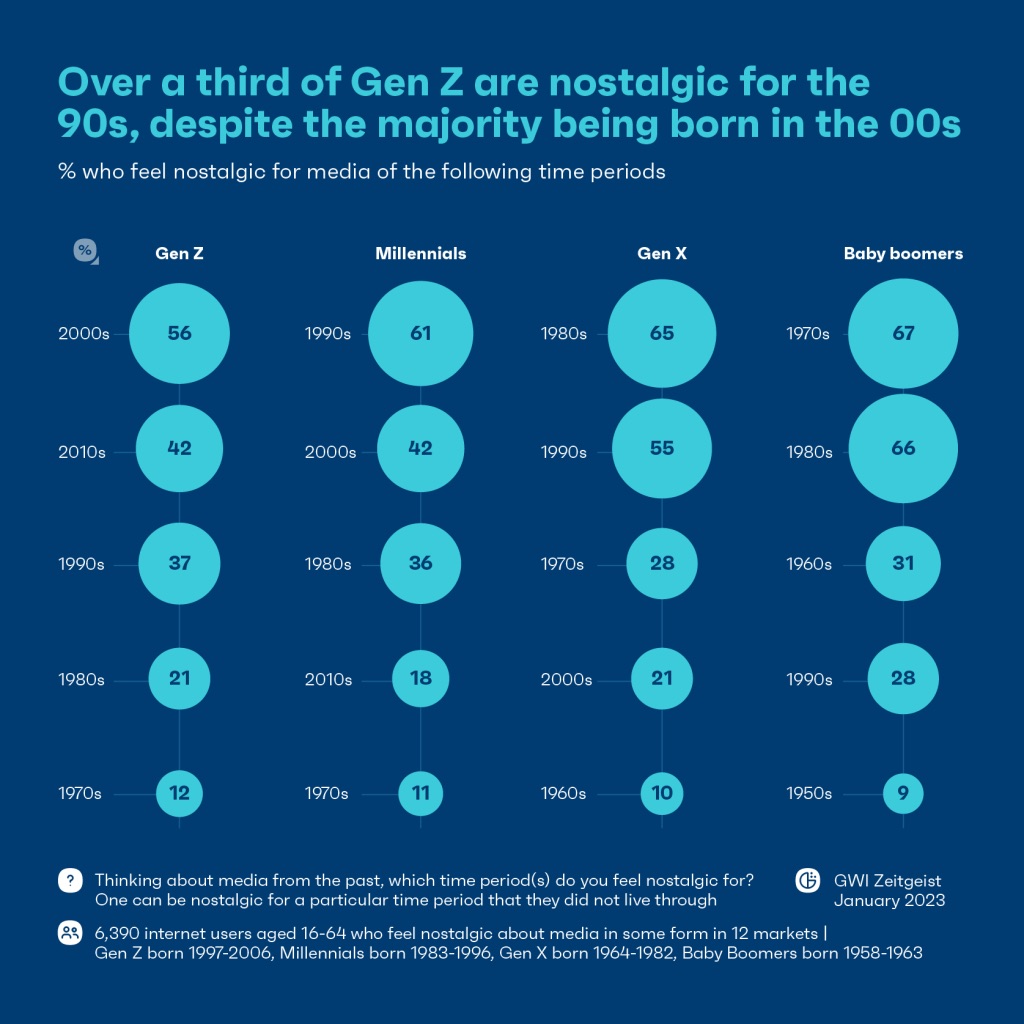
Over a third of Gen Z feels nostalgic for the nineties even though most of them were born after 2000. They miss something they never lived through. They miss the idea of a life with fewer interruptions, less performance, and fewer digital obligations. Essentially, they miss a pace that their own childhood never offered them.
In my Photo Fatigue article, I wrote about how we drown in digital memories we never actually experience. We take thousands of photos we never look at. We save everything and touch nothing. So of course a generation raised inside this digital flood is now reaching for objects that force them to slow down — not because they are vintage, but because they have limits.
- Polaroid gives you one chance.
- A vinyl record forces you to listen in sequence.
- A Walkman makes you commit to an album.
- Wired earphones stay loyal in ways Bluetooth never will.
These aren’t quirky choices. These are boundaries, real ones,in a life that rarely offers any.
This is also why “retro” doesn’t mean going backward. It means choosing tools that don’t report your behaviour, track your steps, or demand your attention. It’s tech without the scoreboard. And for a generation who grew up inside the scoreboard, that feels radical.
The Search for Comfort
This trend isn’t a nostalgia trip. It’s retro blended with practicality. And it lines up with something I explored in The 7th Wonders of the Modern World, where I wrote about objects that deserve appreciation because they have weight, because they actually exist.
- A flip phone gives you peace.
- A smartwatch keeps the health stuff.
- A Fujifilm camera looks retro but still uploads your photos.
And a record collection gives you ownership of something your streaming subscription can’t disappear overnight.
These choices are grounded, not aesthetic.
In my Moment of Realization article, I wrote about the fact that the nineties are closer to the 2020s than the sixties were to the nineties, a gap that messes with our sense of history. The line between decades has flattened. Trends recycle faster than we can process them. Gen Z treats the nineties the way millennials treated the seventies: as a menu.
This is what makes the throwback trend feel so logical.
It isn’t about the past.
It’s about clarity.
Buying things second-hand and using older devices also just feels better than upgrading every six months. It’s sustainability without needing to post it on Instagram with a hashtag.
Escapism Without Apology
Older tech has quietly become a doorway out. A small, private exit from the noise. These things give people moments of focus and focus has basically become a luxury skill.
And this brings me back to something I wrote a long time ago in Throwback to 1996. I described how ordinary life was before everything went digital. You waited for a show. You recorded a movie. You hoped no one taped over it. You lived inside limits you didn’t even notice.
That simplicity wasn’t a lifestyle or an aesthetic. It was just how things worked. And now, ironically, that simplicity feels like the one thing we can’t get back unless we buy it second-hand.
People aren’t idealising the past. They’re trying to survive the present. The throwback trend creates small, quiet moments of calm. Moments of slow over instant. Moments that feel human. It isn’t rebellion. It’s relief. And that’s exactly why it works.

 Jackinna of all Trades