We live in a time when music is expected to fade into the background. Everything’s been optimized for the scroll: short songs, no intros, instant hooks, skip-proof vibes. Playlists are curated to never offend or interrupt. Music is no longer an experience; it’s an ingredient for productivity or a soundtrack for stories. In this soft, reactive ecosystem, rock music doesn’t make sense anymore. Because rock was never designed to be quiet (or to shut up).
I can still remember the first time I heard Bon Jovi’s “Livin’ On a Prayer” blasting through my headphones. It was like electricity going through my veins. Same with the first time I heard the Red Hot Chili Peppers and their raw, rebellious, energetic sound. Every song felt like it had a story, a beginning, middle, and end. The highs, the lows, the unexpected turns. Each song pulled you in and kept you there until the last note.
In this soft, reactive ecosystem, rock music doesn’t make sense anymore. Because rock was never designed to be quiet (or to shut up).
But today? When I listen to some new music, I can’t tell where the song even started or ended. It’s optimized, engineered to sound good no matter what. There’s no rawness, no edge. It feels like the soul of the music has been replaced by perfection. Music has become background noise, designed to be seamless, distraction-free. But where did the feeling go?
Rock was Nokia. Hip-Hop became Apple.
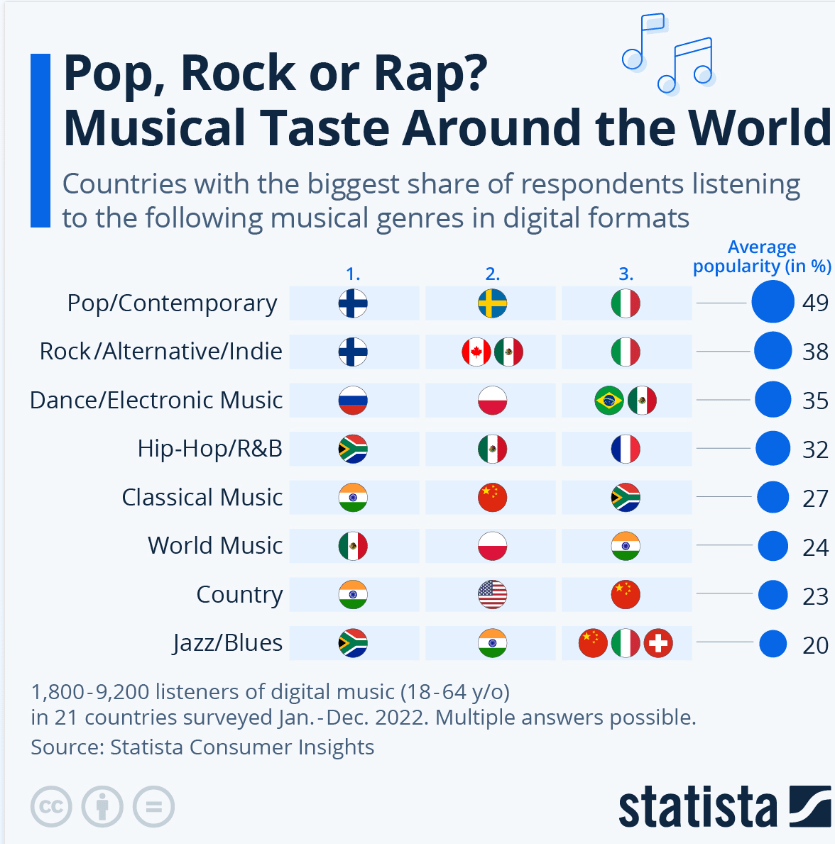
According to a global study from Statista, rock isn’t topping the charts anymore. Pop and hip-hop dominate globally. Sure, rock still holds its ground in countries like the U.S., Germany, and Finland, but even there, it’s being edged out by genres that align better with today’s algorithms.
To understand what happened to rock, stop thinking like a fan and start thinking like a strategist.
Nokia built something legendary and then froze. For years, it was the default phone: durable, beloved, and familiar. People didn’t think of phones; they thought of Nokias. But when the world changed, so did the interface and expectations. Nokia didn’t adapt. It doubled down on what had always worked: buttons and legacy. Meanwhile, Apple didn’t just redesign the phone. It rewired how we interact with everything. Clean, fast, intuitive, and future-facing, Apple listened to the culture and led it.
Rock stayed loyal to its history. It relied on the same riffs, the same formulas, the same big names headlining the same festivals. Nostalgia became a business model, with re-releases, remasters, and anniversaries. Rock didn’t evolve the way hip-hop did. It didn’t innovate or shape culture the same way. Instead, it held tight to its past.
Hip-hop, on the other hand, adapted. It didn’t just dominate music; it shaped culture. It took over TikTok, YouTube, fashion, and identity. It became an ecosystem, an ever-evolving force with personalities like Snoop Dogg building brands that transcend music.
Rock’s strength is its collective energy
Rock is built to interrupt. It’s not background music; it’s designed to make noise, kick, and scratch. It forces its way into your bloodstream, daring you to feel something. But in a culture addicted to smooth transitions, that intensity doesn’t just feel outdated; it feels confrontational. That’s not a flaw. It’s rock refusing to be perfect.
Rock is about bands. It’s not about following one leader; it’s about the collective energy between them. Guns N’ Roses? People argue whether it’s Axl or Slash. Hanoi Rocks? Andy McCoy’s guitar is just as iconic as Michael Monroe’s vocals. Mötley Crüe? Nikki Sixx arguably shaped the band’s legacy more than any frontman. Led Zeppelin? You’re either a Jimmy Page or a John Bonham. Rock’s magic is in the chemistry, in the dynamic between band members.
Rock is built to interrupt. It’s not background music; it’s designed to make noise, kick, and scratch. It forces its way into your bloodstream, daring you to feel something.
One of rock’s biggest problems is its fixation on nostalgia. Re-releases and remasters keep the genre in a loop. Fans often prefer to celebrate old heroes rather than embrace new ones. But nostalgia can only take you so far. As comforting as it is to hear “Bohemian Rhapsody” or “Sweet Child O’ Mine” for the thousandth time, who will write the songs that define the next generation?
Sure, hip-hop has taken over the mainstream. And honestly? It earned it. Hip-hop adapted. It innovated, fractured into microgenres, and gave younger generations something that felt theirs. It got sharper, faster, global, and viral.
The future: can rock evolve?
The future of rock depends on whether it’s willing to take risks again. The genre needs to stop romanticizing its past and start embracing the future. Many of rock’s greatest moments came from artists who were bold enough to redefine the genre. The key to its survival lies in innovation. In blending old with new, experimenting, and drawing influence from the music landscape around it.
Take Ghost for example. The Swedish band has mastered the art of creating a theatrical, larger-than-life persona while staying incredibly active on social media. They blend metal, rock, and theatrical performance, capturing the attention of younger generations who may have never considered rock as a genre for their playlist.
Closing remarks
Before we wrap up, let’s not forget the timeless power of rock. Tracks like Evil Woman by Electric Light Orchestra and Born in the U.S.A. by Bruce Springsteen still carry an energy that’s as alive today as it was when they first hit the airwaves. Ghost, Battle Beast, and classics like Livin’ on a Prayer and The Trooper continue to push boundaries, keeping rock’s fire burning.
The future of rock depends on whether it’s willing to take risks again.
So, why has rock slowed down? Maybe it’s not gone; it’s just waiting for the next revolution. The next Square Hammer to tear through the speakers and set a new generation on fire. It might not be topping charts, but rock never truly left.
As long as songs like The Idol by W.A.S.P., Fear of the Dark by Iron Maiden, and Still Loving You by Scorpions remain in our playlists, the rebellion isn’t over.
The future of rock? It’s unpredictable, but one thing is certain: it’s going to be loud.
🎧 “Evil Woman” – Electric Light Orchestra
🎧 “Dancing In the Dark” – Bruce Springsteen
🎧 “Born in the U.S.A.” – Bruce Springsteen
🎧 “Back In Black” – AC/DC
🎧 “Dream On” – Aerosmith
🎧 “Sweet Child O’ Mine” – Guns N’ Roses
🎧 “Don’t Stop Believin'” – Journey
🎧 “Ritual” – Ghost
🎧 “Square Hammer” – Ghost
🎧 “Mary on a Cross” – Ghost
🎧 “Livin’ On a Prayer” – Bon Jovi
🎧 “Tallulah” – Sonata Arctica
🎧 “Touch in the Night” – Battle Beast
🎧 “The Trooper” – Iron Maiden
🎧 “Fear of the Dark” – Iron Maiden
🎧 “Only the Good Die Young” – Iron Maiden
🎧 “The Idol” – W.A.S.P.
🎧 “Wild Child” – W.A.S.P.
🎧 “The River” – Good Charlotte
🎧 “Shot in the Dark” – Ozzy Osbourne
🎧 “Riders on the Storm” – The Doors

 Jackinna of all Trades