The Oscars (Academy Awards) have long been regarded as the highlight of cinematic achievement. But in an era where audience reviews, social media reactions, and streaming platforms have amplified the voice of the viewer, it begs the question: do we really still need an exclusive insider group to determine what films are “the best”?
There are exceptions, of course. Films like Get Out (2017)—nominated for 4 Oscars and won 1— Dunkirk (2017)—nominated for 8 Oscars and won 3— Joker (2019)—nominated for 11 Oscars and won 2—and Oppenheimer (2023)—nominated for 13 Oscars and won 7—have pushed boundaries and broken away from the Academy’s typical choices. But too often, I think that the nominations feel disconnected from the pulse of today’s moviegoing audience.
Barbie: A Hit and a Controversy
In the Barbie movie, I found myself diving back into that pink world I adored as a kid nearly 30 years later. This vibrant movie is a 2023 comedy directed by Greta Gerwig, known for her previous works Lady Bird (2017) and Little Women (2019), both of which earned her nominations for the Academy Award for Best Picture.
Margot Robbie stars as the iconic doll, while Ryan Gosling portrays Ken. The plot follows Barbie and Ken on a journey of self-discovery as they move between Barbieland and the real world after Barbie experiences an existential crisis. The ensemble cast includes America Ferrera, Michael Cera, Kate McKinnon, Issa Rae, Rhea Perlman, and Will Ferrell. The movie was a commercial hit and received eight Academy Award nominations, including Best Picture, Best Adapted Screenplay, and Best Original Song. Ultimately, Barbie won one Oscar for Best Original Song.
One of movie’s central themes is its exploration of body image and self-acceptance, encouraging viewers to rethink traditional beauty standards. The movie sparked conversations about being “anti-male” due to its depiction of a women-dominated society where Kens are portrayed as marginalized add-ons. This controversy likely contributed to Barbie receiving eight Oscar nominations and one win. Many were outraged by the Academy’s failure to recognize Greta Gerwig’s directorial work, igniting backlash both online and within the film industry. The Associated Press described Gerwig’s exclusion as “one of the biggest shocks in recent memory.” Additionally, the movie presents a complex relationship with consumerism and commercialism; while it critiques Mattel as a patriarchal entity, it remains a major studio production licensed by the very company it criticizes.
Who said the Oscars aren’t political?
The Oscars have often been seen – or at least used to be seen – as a celebration of cinematic achievement, but over the years, it’s become clear that they also reflect broader social and political issues. The selection process and the films that win or lose can be influenced by various factors, including race, gender, and societal expectations. It’s not a surprise that the awards have been criticized for not being inclusive enough, not recognizing films and filmmakers from diverse backgrounds. For instance, the #OscarsSoWhite (a social media campaign from a movement started by activist April Reign to critique Hollywood’s racial discrimination). in recent years there has been a growing movement in the film industry to better represent Black and LGBTQ+ people both on screen and off.
Who votes for the Oscars?
The Academy of Motion Picture Arts and Sciences, founded in 1929, has over 10,500 film industry artists and leaders as members, organized into 18 branches. While nominations are mostly decided by members of the specific branch (e.g., actors nominate actors, editors nominate editors), all active members of the Academy of Motion Picture Arts and Sciences can vote in every category, including Best Picture, to choose the winners.
Interestingly, not all Academy voters are required to watch every nominee, as CNN explains. A 2015 study revealed that about 6% of voters didn’t view all the Best Picture nominees, raising questions about the selection process’s integrity.
What I originally thought the process would be is that there were special movie premieres just for Academy members, and they had to attend in order to be eligible to vote. But it seems there isn’t anything like that, and there’s no guarantee that the voters have actually seen the movies.
For the last 20 years, Hollywood studios and production companies have hired experts to run Oscar campaigns, spending millions of dollars to get the attention of the right voters who could help their films win, according to Vox. Vox explains that the road to the Academy Awards has become not only costly but also exhausting, with an increasing focus on marketing rather than the artistry of filmmaking itself.
Every piece of a successful Oscar campaign is focused on crafting the belief in voters’ minds that this movie not only can win, but should. That’s what makes for an “Oscar movie.” And running the campaign often starts with everything but the movie itself.
How to win an Oscar, Vox
This reliance on promotional efforts signals a major shift in how films compete for recognition at the Oscars. As studios invest significant resources into these campaigns, there’s a risk that the focus may shift from the genuine quality of the films to the effectiveness of their marketing strategies. The Oscars often highlight films that have been extensively promoted and have garnered attention at major film festivals.
What’s the Deal with Who Wins and Who Doesn’t? Is There an “Oscar-Worthy” Formula?
Starting this chapter in an old-fashioned way: Why do some films win Oscars while others get left in the dust? Is there a secret recipe for what makes a movie “Oscar-worthy”?
First, many films that win Oscars tend to share common traits. They often feature strong character arcs and complex narratives that dives into emotional and social issues. Movies like The King’s Speech and Moonlight showcase personal struggles that resonate deeply with audiences and voters alike. According to experts, films that present significant social themes or tackle historical events often catch the Academy’s attention because they evoke a sense of importance and relevance .
Period dramas hold a special place in the Academy’s heart, as they often exhibit elaborate costumes and historical settings, appealing to voters’ appreciation for craftsmanship and storytelling rooted in history from generation to another. Similarly, emotionally intense narratives that dives into relationships and personal struggles are popular, as they allow for rich character development. Serious dramas have a long history of dominating the Oscars, while genres like comedy and horror are often overlooked.
Well, here is one way to look at it through an infographic.
Fictional North American characters live in either the present day or the recent past, often as soldiers, law enforcement officers, or performers. The films do not include sexual scenes, and the characters do not die on screen.
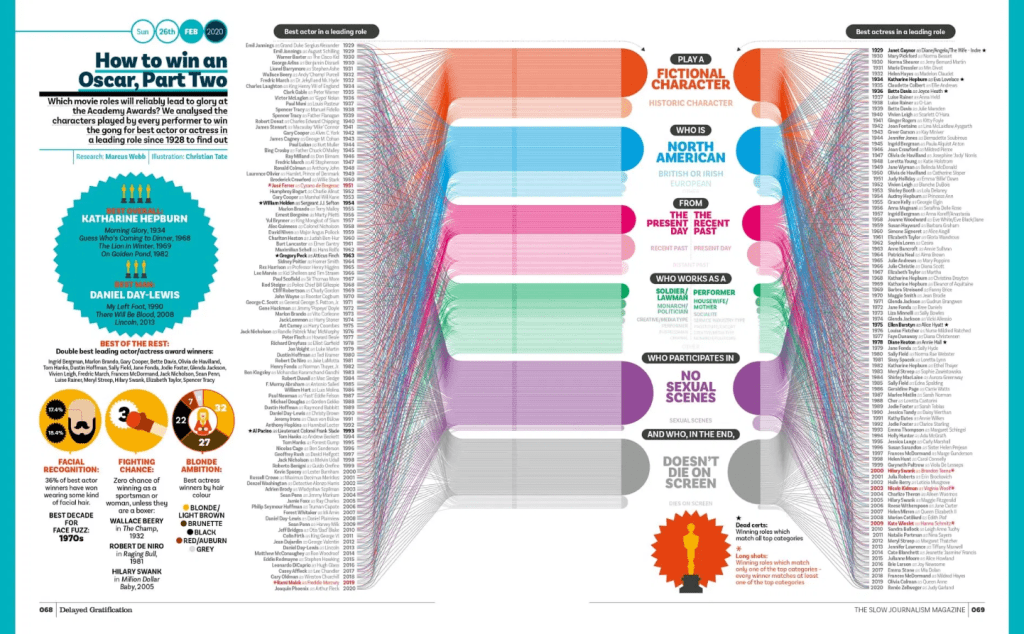
Some actors with mixed reviews, like Halle Berry, Jared Leto, and Casey Affleck, have won, while others—arguably just as deserving—haven’t. And then we have movies like Barbie, the English Patient, The Hours, and The Moulin Rouge, for instance.
The English Patient is often praised for its romantic epic tone and stunning visuals, but I found it slow and overly sentimental. Despite its nine Oscar wins, it felt like the Academy rewarded a traditional, safe choice rather than something bold. The Hours left me emotionally exhausted with its heavy-handed themes, but it was exactly the kind of movie that the Academy loves to praise. And Moulin Rouge!? Sure, it won for Best Art Direction and Best Costume Design, but I found the visuals exaggerated, overshadowing any emotional depth.
This makes me question whether the Oscars truly reflect the best in filmmaking or if they’re influenced by marketing efforts. With so many talented actors not receiving recognition, it raises some questions about how these awards are determined.
It’s clear that the awards no longer define a film
Ultimately, while the Oscars still carry a certain prestige, their relevance is becoming increasingly debatable. With the rise of streaming platforms and social media, audience opinions now play a much larger role in shaping a film’s impact. Services like Netflix, Max, and Disney+ have disrupted the traditional movie-going experience, allowing more people to watch films on-demand, rate them, and share their thoughts instantly with the world.
The Oscars once held great power, symbolizing the highest achievement in cinema. Before television and the internet changed how audiences engaged with films and filmmakers, the Academy Awards were major cultural events that provided a rare glimpse into the lives of the rich and famous. Winning an Oscar was considered the ultimate recognition of talent, hard work, and artistic achievement. However, in today’s streaming-dominated era, it no longer holds the same significance.
This democratization of criticism has made it clear that a film’s success is no longer solely determined by industry accolades or critics’ reviews.
The power now lies in the hands of the people. Audiences either support the Oscars by tuning in and following the selections or “vote with their feet” by choosing which films to watch, celebrate, and share. Streaming platforms, social media, and audience-driven ratings (like Rotten Tomatoes or IMDb) show how much viewers have shifted the conversation, often propelling films to success outside of the traditional awards framework. In this way, whether the Oscars remain relevant depends as much on the audience as it does on the Academy’s selections. If people stop engaging with the awards, they lose their cultural weight, making the people’s choice all the more influential.
Why it’s an unpopular opinion
Opinion towards the Oscars might be an unpopular one, as these awards symbolize success in cinema for many. While I understand this viewpoint, I don’t necessary share it. Just because something doesn’t resonate with me doesn’t mean it lacks value for someone else. It’s essential to appreciate and respect those who hold different opinions and perspectives, rather than trying to force them into my own viewpoint. The prestige, glamour, and idea that winning an Academy Award is the ultimate stamp of approval have been ingrained in our minds for decades. However, as I grow older, I’ve come to realize that I simply don’t care about it anymore.
You have no idea how much I applauded when Get Out received recognition. It brilliantly combines two of the most challenging genres—horror and comedy, even if the comedy is subtle. The Oscars have a serious reputation, which often leaves genres like horror and comedy out in the cold. The Academy tends to focus on heavy narratives—think of the usual line-up of dramatic performances and emotional depth—while overlooking the richness that these genres can bring to cinema.
Ultimately, the Oscars need to broaden their definition of what constitutes great filmmaking. By recognizing various genres, the Academy could better reflect the full spectrum of artistic expression that cinema has to offer. Additionally, the Academy tends to gravitate toward films that tackle significant social issues, such as inequality, war, and personal identity. This focus reflects broader societal conversations and lends a sense of relevance to the awards. On the other hand, genres like comedy and horror are often overlooked, despite their potential for innovation and artistic expression. The lack of recognition for these genres suggests a narrow definition of what constitutes “worthy” cinema.
Ultimately, I don’t need the Academy’s validation to know when a film or actor is great.
The Oscars’ serious nature might stem from a long-standing belief that serious films are inherently more artistic or valuable. This bias overlooks the artistry involved in crafting a well-timed joke or building suspense in a horror film. Ultimately, the exclusion of these genres from Oscar consideration sends a message that only certain types of stories matter, which is not reflective of the diverse landscape of modern cinema.
The Oscars 2035: A Vision of the Future
I believe the Oscars, as we know them today, must evolve to remain relevant. Below, I outline several predictions that could enhance the event’s significance and experience, make it more accessible for fans, and retain the glamour while utilizing technology to promote transparency and democratization. In short, by 2035, the Oscars could enter a new era of entertainment with holographic hosts and AI-assisted presentations.
1. Virtual Red Carpet Experience
Imagine a red carpet event that fans could attend virtually, utilizing the possibilities of the metaverse, from Imagine a red carpet event that fans can attend virtually, utilizing the possibilities of the metaverse from anywhere in the world. They could experience the Hollywood glamour of the Oscars through holographic projections, allowing viewers to project themselves alongside their favorite stars, take selfies, and engage with the ceremony in real time, no matter their physical location.
2. Gamified Voting System
In 2035, the Oscars could adopt a blockchain voting system that democratizes the awards process by shifting responsibility away from insiders to the public. Gamification could become central to the awards, enhancing interaction among attendees and enriching the virtual event experience. Fans could earn points for predicting winners, participating in trivia and quizzes, and engaging in live polls during the ceremony. These points could lead to various rewards, such as exclusive merchandise or virtual meet-and-greets with nominees, effectively merging both worlds. This approach would not only boost viewer engagement but also foster a sense of community among fans.
3. Collaboration with AI
There won’t be a place where AI is not touching in 2030s. This collaboration between AI and the real world could involve a special award for movies created with the assistance of AI technologies, showcasing the synergy between technology and creativity. This initiative would demonstrate how AI can inspire fresh ideas in the film industry, streamlining the filmmaking process and allowing creators to focus on their artistic visions. Also, AI could enhance user experience by analyzing viewers’ preferences and providing personalized content recommendations based on their favorite genres, actors, or directors, making the ceremony feel more relevant and engaging for each individual. Think of personalized movie trailers, for instance. Considering the number of tech startups and scale-ups, I see a lot of possibilities here.
4. Broadcasting with Satellite Events
The Oscars could feature multiple live broadcasts from different countries, potentially in a pre-show format that highlights local talent and films. This global strategy would celebrate diversity and cultural aspects, transforming the Oscars into a truly global event rather than solely a U.S.-based gathering given by few and selected. As we see how just in 30 years the celebrities are turned from someone fans can only collect information and content from, like posters and read books, now to interact with Instagram, for instance. This leap forward would perhaps make the Oscars more intimate, accessible and engaging for a global audience, fostering a deeper connection between fans and the film industry.
5. Augmented Reality Festival Apps
The official Oscars app could allow attendees and remote viewers to scan their environments and unlock exclusive AR content, such as behind-the-scenes footage, character interactions, and other augmented performances.
6. Streaming services to be part of the Oscars
In the future, streaming movies, including those from platforms like Netflix, could clearly have a place at the Oscars, as they have already democratized access to cinema, allowing a broader range of films to reach diverse audiences. This could change distribution and accessibility.
These technologies could play a significant role in making ticket prices more moderate, perhaps utilizing dynamic pricing options. The pricing reflects not only the staffing and energy costs associated with running a cinema but also the substantial investments required to ensure that customers enjoy the best possible experience with the latest advancements in sound and vision technology. If AI and other disruptive technologies can help maximize cost-efficiency, everyone could benefit from lower ticket prices and streaming membership fees.
Closing remarks
As we look ahead to the next decade, the Oscars may keep some of their traditional presence, to adapt to the evolving landscape of cinema and audience expectations.
The usage of advanced technologies at the Oscars by 2035 could presents several concerns and potential problems, such as privacy and data security because exploring virtual and augmented reality, as well as AI-driven personalization, there will be more reliance on collecting and processing user data. This raises serious questions about how that data will be stored, used, and protected. Also, the potential for gamification and blockchain voting raises questions about the integrity and authenticity of the awards process.

 Jackinna of all Trades